
Were You in an 18-Wheeler’s Blind Spot? How No-Zones Affect Your Accident Claim
Posted on: August 11, 2026After an accident with an 18-wheeler, hearing that your vehicle was in the truck’s blind spot can make it feel like you’re already to blame. These large blind spots are often called “No-Zones,” and they may quickly become a major focus of the company’s investigation.
It can also make it feel like your case has already been decided. It hasn’t.
Where your vehicle was located matters, but so does how it got there and what the truck driver did before the crash. The trucking company may use the No-Zone to place as much blame on you as possible and reduce what it has to pay.
Understanding how these blind spots work can help you see what is really being questioned and why your rights need to be examined just as carefully.
What Is an 18-Wheeler’s No-Zone?
Every vehicle has blind spots—areas around the car that the driver can’t see. Around an 18-wheeler, those blind spots are much larger, extending in front of the cab, directly behind the trailer, and along both sides of the truck. These four blind spots are collectively known as the truck’s “No-Zones.”
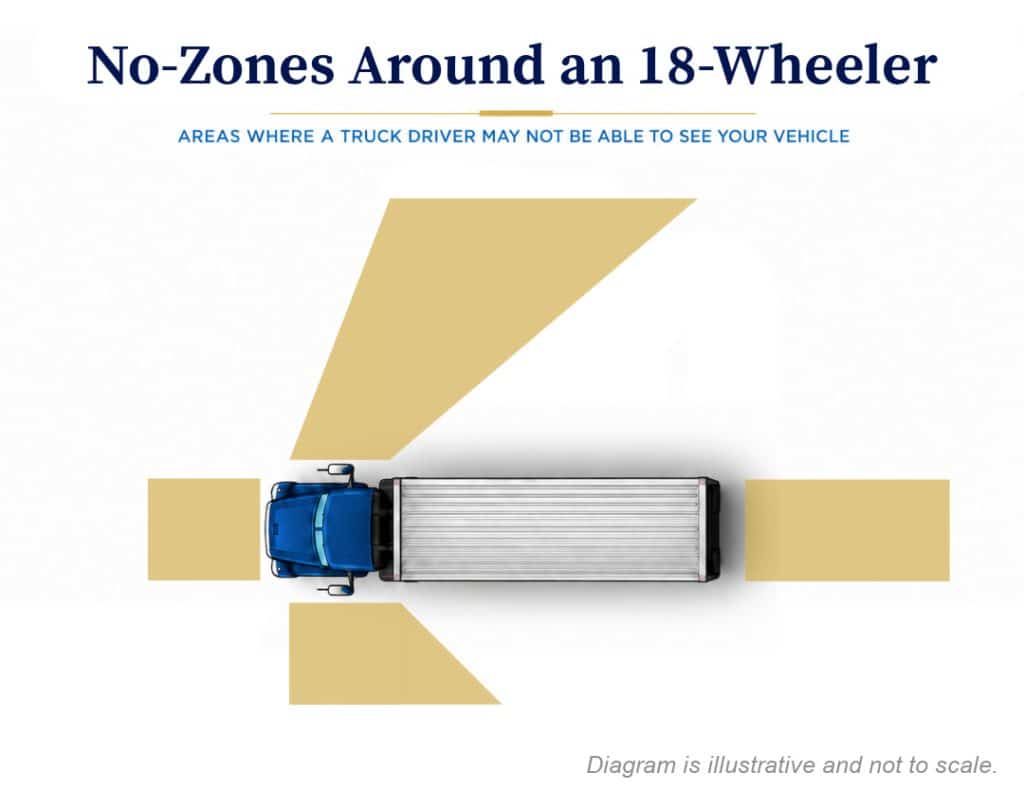
The driver sits high above the road, the trailer extends far behind the cab, and there is no rear window that allows the driver to see directly behind the truck. Side mirrors help, but they cannot provide a clear view of every area surrounding such a large vehicle. As a result, cars traveling in one of these areas may disappear from the truck driver’s view entirely.
Because of this, drivers are often given guidelines for driving alongside 18-wheelers: avoid driving in a truck’s No-Zone and pass through it promptly rather than lingering in the blind spot.
That advice can reduce the risk of a crash, but it can’t prevent every accident. Traffic slows, lanes merge, and vehicles sometimes remain beside a truck longer than anyone intended. When a collision happens, the fact that your vehicle may have been in one of these No-Zones becomes part of the investigation—but not the entire answer.
How Can the Trucking Company Use the No-Zone Against You?
After the crash, the trucking company may focus heavily on where your vehicle was at the moment of impact.
It may argue that you:
- stayed beside the truck for too long,
- followed too closely behind it,
- passed from an unsafe position,
- merged too closely in front of it, or
- should have realized the truck driver couldn’t see you.
The trucking company and its insurer use these arguments to place as much responsibility on you as possible and limit what they have to pay.
If they are able to provide evidence, the trucking company will likely use your position in the No-Zone to argue that you contributed to the crash. But it can’t be used as definitive evidence and it should never be looked at in isolation.
Fault depends on the full sequence of events, not one snapshot from the moment of impact. Being in a No-Zone can be part of the investigation, but it is not proof that you caused the accident.
A strong investigation should also ask:
- Did the truck driver check the mirrors before changing lanes or turning?
- Did the driver use a turn signal and leave enough time for nearby vehicles to react?
- Was the truck traveling too fast for the traffic or road conditions?
- Did the driver drift out of the lane or make an unusually wide turn?
- Was the driver distracted, fatigued, or otherwise unable to pay proper attention?
- How long had your vehicle been beside the truck, and did the driver have reason to know it was there?
The fact that a truck has blind spots does not excuse the driver from using reasonable care. Truck drivers are responsible for checking their surroundings and making sure a movement can be made safely before they act.
How to Determine Fault After an Accident
By the time you start asking questions, the vehicles have likely been moved, the road reopened, and the visible signs of the crash cleared away. That doesn’t mean all the evidence is gone.
Investigators may be able to piece together what happened using:
- the police crash report,
- statements from drivers and witnesses,
- photographs or videos taken at the scene,
- damage to the vehicles,
- traffic cameras or nearby business surveillance,
- the truck’s onboard cameras and electronic data,
- possible dash cams or cameras from nearby vehicles
- driver logs and dispatch records,
- inspection and maintenance records, and
- accident reconstruction when the cause of the crash is disputed.
This evidence can help show where each vehicle was, how the truck moved, whether the driver had time to see you, and what happened in the seconds before impact.
How a Truck Accident Attorney Can Help
After a truck accident, it can be tempting to let the insurance companies sort out what happened. But the insurance companies aren’t neutral observers. Each insurance company (even your own!) will be focused on minimizing the amount they have to pay. Furthermore, the trucking company will have its own investigators, safety personnel, and attorneys working almost immediately to protect its side.
“After a serious truck accident, the trucking company may send someone to the scene immediately to take photographs, speak with witnesses, and begin collecting evidence. From the company’s perspective, the defense of the case begins as soon as it receives the call.”
— Jim Gordon
You can level the playing field by having a truck accident attorney on your side who understands truck accident cases and has experience representing injured victims. A good attorney can also identify the evidence that needs to be preserved and act quickly, before that evidence is deleted, damaged, or lost.
The trucking company is unlikely to turn over helpful information without being asked the right questions. As time passes, important records, electronic data, and video footage may also become harder to obtain.
We’re On Your Side
The trucking company is already building its version of what happened. You deserve someone who will investigate the crash just as carefully and make sure the No-Zone argument isn’t the only story.
At Beers & Gordon, our attorneys previously worked on behalf of insurance companies, so we understand how insurers investigate claims, assign blame, and look for ways to reduce what they pay. We use that experience to protect injured clients and build cases around the full evidence—not one detail taken out of context.
If you were injured in an accident with an 18-wheeler, contact Beers & Gordon for a free consultation. We will review what happened, explain what may affect your claim, and help you decide what to do next.